mandag den 30. januar 2012

Hua jiao

Although I find Cheng Du fascinating, the main reason I am happy to be back in Hong Kong is the cuisine. While Hong Kong has a multitude of restaurants hailing from all over the globe, it still maintains some local tastes and fragrances. But these are mild and appeal naturally to the Western taste buds. There is a very clear regional influence on cuisine, and Cheng Du was no exception.

The most powerful taste I experienced was "Hua jiao", 花椒 - literally "flower pepper", and known in English as Sichuanese pepper. It bears no resemblance to black pepper as we know it in the west, but instead has a reddish shell and an acidic, almost citrus, smell. It is used in hot pot, as well as in most local dishes, so we experienced it a number of times.

On such time was the first evening in Cheng Du. We went to an old park, which had touristy stalls, as well as museums, eateries and restaurants. There we had a hotpot dinner at an old, traditionally decorated restaurant, with entertainment in the form of dancing, music, and "Bian Lian" - 变脸,literally "face change", a part of the Sichuanese opera where performers switch masks with lightning speed.

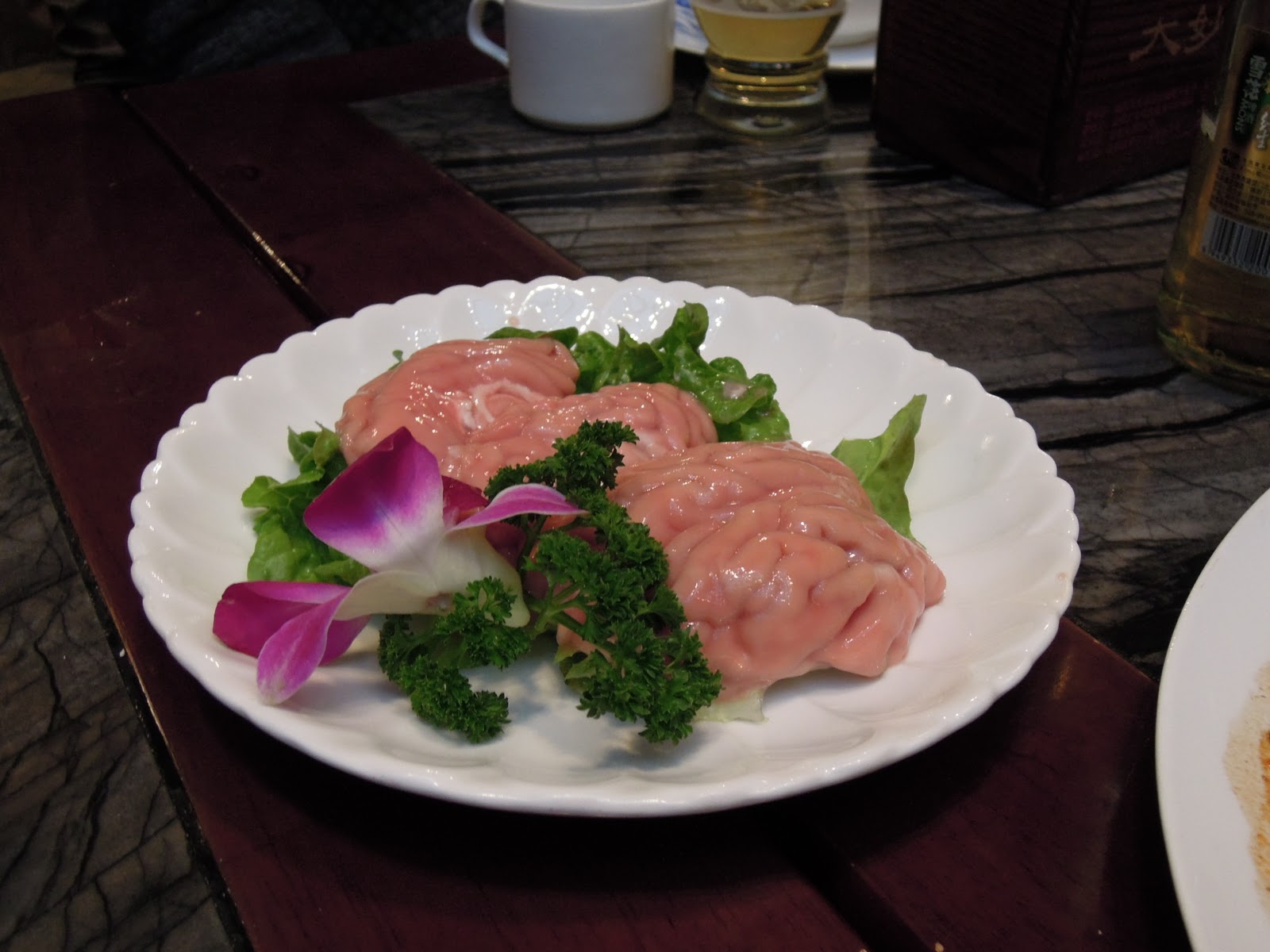
Instead of the usual single big pot, we had 4 smaller "chambers" with varying degrees of seasoning with hua jiao and chilli. The smaller bowls in the foreground were to mix with soya sauce to create a dip for our boiled ingredients. The aroma from the pot was heavy, slightly nauseating, resembling the light-headedness one gets by inhaling vinegar fumes for too long. We helped ourselves to lettuce, lotus, potato, pork, beef, fish balls, and the oddity of the evening, pig brains (of which I only had a couple of mouthfuls). The hua jiao contains a chemical which numbs the lips and mouth, and the hot chilli made it an almost pleasant sensation after a couple of minutes. The downside was that we didn't eat that much (since hotpot is not that heavy, and the fumes of hua jiao took away our appetites). But that was apparently expected as we were stuffed full of oranges, tangerines, raisins, walnuts and, my favourite, mangosteens (a hard purple fruit that looks like an onion, but can be cracked to reveal a couple of sweet, white segments) when we returned to our loggings.

søndag den 29. januar 2012

Media censorship

Another peculiarity of China - media censorship. Seen with Western eyes, censorship a violation of a fundamental human right. Especially the American GLOBErs have (surprisingly) strong views against censorship, and maintain that the freedom to gather information to make an informed decision in life is one of the most important functions in developing as a person, as well as a society. Danes seem a little more indifferent, but still maintain that an autocratic ruling party should not decide what people should and should not see and listen too. (But then again, we put up with bizarre micromanagement like the Danish fat-tax, something the Americans were profoundly annoyed by).

China has one television station, CCTV, having the all-powerful right to decide what to show on television (of course as dictated by the Communist Party of China), but it has several channels, some 40 of which were variable at our hotel room. They all show the same: Chinese talk shows, Chinese movies, and a LOT of Chinese adverts (There were probably also some nature programmes in there, but when everything is in Chinese, you kind of just flip mindlessly through the channels). At one point there was Li Na's tennis match at the Australian open, but generally the options were limited. I watched the last hour of a traditional film, in part to experience the film culture of China, and in part to see if I could pick out any Mandarin words. Not bad, but with immensely long periods of silence and dramatic violins in the background, it is nothing like Hollywood.

Regarding the Internet, China has banned numerous sites such as Facebook and Youtube. But Google is allowed, and I thus had time to check my gmail. But the connection speed is dire, and since most relevant servers were far away (i.e. Europe or Hong Kong), it was a test of patience rather than a pleasant experience. Also, photos take like 10 minutes to load, so even loading BBC or Bloomberg took time.

Talking to the father of our Chinese host, I asked him whether he thought this censorship was a bad thing. He didn't think so, but for very different reasons than I expected. I assumed that the fear of free internet was to do with uprisings against the regime, such as the one in Urumqi in 2009 (which, I admit, I still have some ideas about), but the father's main concern was with the erosion of Chinese culture. I later learned from a friend that pornographic images is another concern, strictly clashing with the upbringing of Chinese children (some schools state on graduation papers from high school whether the person has been in a relationship, since that would be considered as slacking off and not fully prioritising school). But China has many loop holes, and if you want to use Facebook in China, there are ways you can. But why would you, since a Chinese company has pretty much copied the concept with the web page "Renren" (literally "People people", meaning everyone), so all your friends use that instead.

It is strange (from a Western perspective) that Chinese value heritage and culture more than individual freedom. But as the father said, China has over 1,3 billion people, hailing from very different backgrounds. Chinese are more locally minded than nationally minded, which makes sense for a European (we could never envision a United States of Europe). This difference within the population, as well as its size, makes it impossible to let people do what they want - that has been done in the past, with fragmented provinces and kingdoms fighting each other for millennia (not unlike Europe). The Chinese do have more in common than Europeans, with some +90% of the population belonging to the ethnic group of Han Chinese. The Communist Party acts as a massive lightning rod, dictating certain rules and regulations, but bringing peace, prosperity and optimism to millions. As such, the father said that Chinese democracy not only was impossible, it was not even worth aspiring to. Different background, different view points, but in some harsh way, at this stage in Chinese history, I think I agree with him.

lørdag den 28. januar 2012

Giant Pandas

I vowed to not write a "I did this, then I did this, and then..." blog for various reasons, the most important ones being it focusses on chronology rather than events and it makes for unimaginably dull reading. So mulling over what topics were relevant, this one popped up.

Granted, seeing Giant pandas was not the most important event on my trip, but they do make for good discussions. We spent a sunny afternoon in The Giant Panda Breeding and Research Base in Cheng Du, and I accidentally opened Pandora's box by saying that Giant Pandas, from an evolutionary point of view, would not survive without human help, a phrase some girls took to mean that I was a savage, heartless bear-slaughterer. Here is the argument:


Giant Pandas are known as "living fossils", meaning that there are an old species. Species on average only last 2-3 million years before they are replaced by new species (evolution / extinction), but the Giant Panda has been around for more than 8 million years. These species often have few close relatives (evolutionary speaking), since the common link with other animals is considerably earlier.

Giant Pandas are smaller than most big bears, around 5 feet long and weighing some 250 pounds. They seem shorter (granted, I have not seen many other bears) since their back is curved, as they seem to spend a considerable amount of time sitting down. Their diet is 99% bamboo, and they can eat up to 30 pounds of shoots a day (their favourite part).

So far, they have survived for such a long time, precisely because of their few numbers. Their diet restricts them to areas with bamboo, an area which could have spanned the size the Europe before humans entered the scene. They pose no threat to human livestock so never competed with humans (like, say, wolves have), and they are too big to have any natural enemies. But they are in no way adaptive.

Giant Pandas only eat bamboo, which contains almost no nutrition, and they utilize only 20% of what they eat. Instead of diversifying their diet, they spend around 16 hours a day eating bamboo and cut down on physical activity, which gives them the appearance of being lazy (it is so bad that sexual reproduction can be too physically strenuous that they just don't bother - evolutionary suicide). They are solitary animals, not tolerating trespassers on their turf, meaning that the Giant Panda requires a large space for large numbers. This is the main reason they are endangered - human expansion has cut down the size of their habitat (literally).

Reproduction is key to survival, and Giant Pandas are disastrous at it. Females have oestrous cycles once a year, lasting for 2-3 days (!), making it difficult for a lone male to find, court, and mate a female in another territory (especially since they are lazy creatures). They often give birth to two cubs although they can only care for one in the wild. Cubs are born premature every time, do not open their eyes for 6 weeks, cannot crawl for 11 weeks, and weigh a 1000th of the mother. Mothers' also lack a parenting ability, which means that first-time mothers have been seen to get so shocked at the cub's  shrieks that they hit it to death. Perfect.

So will Giant Pandas become extinct in the next, say, 100 years? No. The Chinese are completely mad about them, and the Panda ranks high (below the Dragon) in cultural identity. There has also been huge advances in artificial insemination, alleviating the need for the animals to actually mate. Centers such as the one in Cheng Du also feed the bears extra nutritional cakes and fruit, and has currently bred more than 100 Pandas. But the Giant Panda in the wild, currently estimated around 1600, will still be under threat.

I final remark goes to the Giant Panda as the logo for the World Wide Fund for Nature (WWF). I am not sure whether the logo makes the pathos statement that "we should save cute animals", the ethos statement that "because animals cannot survive, we should help them to", or the logos statement that "without us, animals such as the Panda would be long gone". I subscribe to the second statement; that we should help save the Giant Panda for its cultural influences and its calm, natural beauty. But from an evolutionary point of view, because of human growth and their stubbornness to stay the same, they don't stand a chance.
Cheng Du

Back in Hong Kong after 8 days in China, it seems almost impossible to put into words the multitude of experiences, impressions and understandings which have been gained along the way. So over the next couple of days I will try to provide blog posts which illustrate some of the peculiarities over being a westerner in China.

The goal of this first one is to lay the foundation. Cheng Du is a massive metropolis, containing some 7 million souls (even more, if you count the outskirts of the town), and the city is the capital of the Sichuan province, which is the province just East of Tibet. It has a mountainous geography to the west, but the rolling hillsides around Cheng Du, coupled with the greyish sky and just-above-freezing temperatures, gives it a chilly, damp atmosphere, kind of like autumn in northern England. It's rural location (i.e. not East coast China) means it lacks the same level of investment, and is therefore better known for its long historical heritage, Sichuanese cousine and opera, crafts and arts, and Panda bears.

Historically, the city has been a major city since the 4th century B.C, where the name of the city was changed to Cheng Du, literally meaning "becoming capital". Throughout Chinese war-riddled history, Cheng Du was a major city of the ruling dynasty, and its position as the doorway to Tibet gave it significance, for example as the starting city in the Southern Silk Road (as early as 200 B.C) and for general trade in crafts and tea.

Although I spent most of my time in Cheng Du, I had one day in Shenzhen (located just outside Hong Kong, which is where we flew out from), and two days in Rong Xian, a rural town 4 hours drive south of Cheng Du. (We went there since the trip was organized by a fellow student and friend, whose grandparents live in Rong Xian. During the Chinese Spring Festival, people return home to their local towns to meet up with family - and we were invited along). And that gets me off the mark.

torsdag den 19. januar 2012

Settlers of Catan

After having my final class before the holidays, exchanging some Hong Kong Dollars to Renmenbi, and having a wicked cuttlefish and pork soup-noodle lunch, I parked myself outside the cafeteria in the sun to play a game of Settlers of Catan with 3 fellow GLOBErs.

Settlers of Catan (henceforth known as Settlers) is a 3-4 person board game with the objective to build settlements, gain resources and expand into a sufficiently large civilization before your opponents. It has a multiple-stage element similar to monopoly, but games rarely last more than 1½ hours, so people never get bored. It is the perfect combination of luck, skill, strategy and human interaction (i.e. bartering for resources with your opponents), and the game can quickly turn on its head with a few lucky roles of the dice.

Settlers is an old game and the concept has been copied into numerous computer games I used to play as a kid, such as Civilization, Age of Empires and Railroad Tycoon, and so it naturally had an appeal to me. The board game doesn't have any military element, so it doesn't end up with one all-powerful player like Risk, and alliances are not really necessary or alter a lot, which keeps the fun of "every man for himself". So apart from the "nerdy" remarks by the 4 GLOBE girls who walked past, we boys have found the perfect game that is here to stay!

It has been some time since I last played a board game, but I am sure I'll have more games of Settlers in the future. That will have to wait till after my trip to Cheng Du, where I will spend Chinese New Years. I depart for Shenzhen, which is just over the boarder from Hong Kong, tomorrow at 11:30 AM local time. We take the 2-hour flight to Cheng Du early Saturday morning. So until the 28th in the evening, I am off the radar and thus no blogging..:)

tirsdag den 17. januar 2012

Rush hour

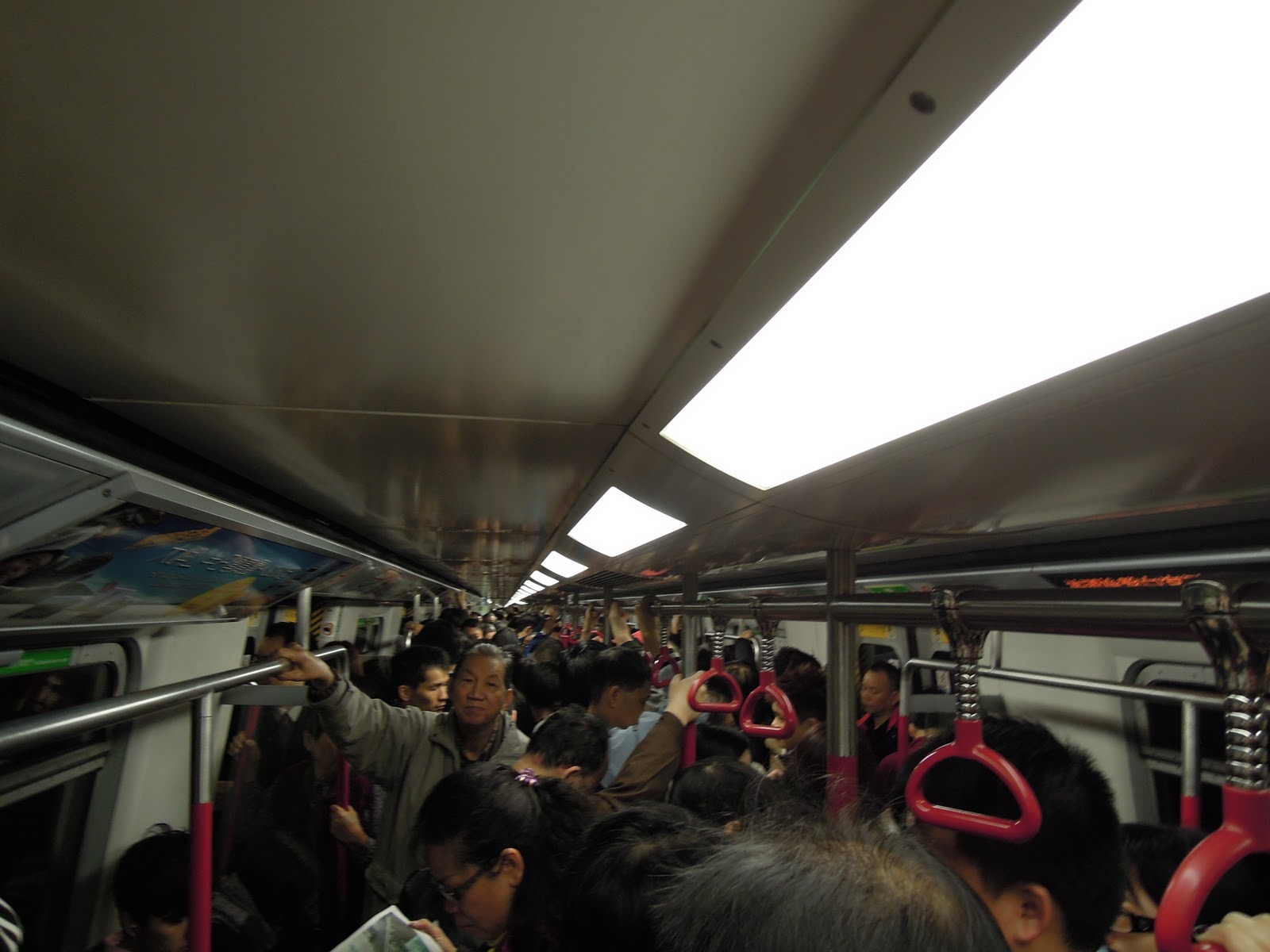
For my trip to Cheng Du this coming week, I needed a visa. The Chinese Embassy is located in Wan Chai, on Hong Kong Island, roughly a hour from the University. Since the place is notorious for long queues, bureaucracy, and a frigid air-conditioning, it is best to be there at 9 AM sharp, when the office opens. However, that means dealing with the Hong Kong rush hour twice, as you have to leave your passport for 4 days for processing, after which you can collect it with the visa.

The MTR in Hong Kong is admired for providing access to almost all parts of Hong Kong at very reasonable prices. Naturally that involves changing trains, but it is a 30 meter walk across the platform most places, and the trains leave, literally, every minute. From University station (which is my stop, go figure) to Wan Chai, you change in Kowloon Tong, Mong Kok, and Admirality (the latter is located on Hong Kong Island). Stop and stop stations are encircled:


My friend Martin and I got on the MTR at university station at 8 AM. The trains were already crammed, trafficking people from the New Territories in the North toward the Kowloon peninsular and Hong Kong Island in the South. Once we crossed under the steep hills and entered Kowloon, we changed to head west for 3 stops towards Mong Kok. Mong Kok is the Nørreport of Hong Kong. It is the heart of the MTR, gathering the flow of people from the North, West and East, and reshuffling them onto the Tsuen Wan line which runs under Victoria Harbour and onto Hong Kong Island toward Central. 


Even though trains leave every minute, the immense flow of people means that there is a hustle and bustle to catch each train. Nice old ladies suddenly become ruthless as they try to weasel their way past other passengers and onto the train. Since I am 6' 3", I wasn't expecting to have to put my weight into holding my ground. Hong Kong does normally have a polite queuing-culture, but on the MTR it is every man for himself.
 
We got to the embassy just past nine, walked in past security, up to the 7th floor, and into a 7 person queue to collect our passports. For the price of 300 HKD I got a 6 month, double-entry visa, while Martin, being French, was only allowed a single-entry (the Chinese don't like the French, so they annoy them which stuff like this). We were out of the building and back on the MTR before 9:30.

Heading home is way more pleasant - the trains are literally completely empty, so I found a seat and read the Daily Standard. We were back at University at 10:30. The other Danes went and got their visas Monday at noon. It took them over 6 hours, trip NOT included, so rush hour was totally worth it. By the way, I paid a total of 14 HKD for the MTR tickets! I love my Octopus card

Chinese Marketing

Even though Chinese New Year, and thus a weeks holiday, is right round the corner, classes have got off to a rocketing start. I am obligated through my GLOBE programme to take Chinese Business, Chinese Marketing, Financial Management and Issues in Asian Business, the later of which will be conducted as a study trip to Singapore in May. I have also enrolled in Introductory Econometrics, which will be useful for my Bachelors Thesis, and of course Putonghua. Each course has three 45-minute classes every week, most of which are consecutive; which means I often only have each course once a week.

Today was Chinese Marketing. With a bright blue sky and 20 degrees outside, it was not an optimal motivation to be sitting inside between 10:30 and 13:15. The topic was "Understanding Chinese Consumers", and for the class we had read 25 pages of articles about Chinese consumer-patterns, including McKinseys annual report on China for 2010. It seemed an interesting, very relevant, and culturally enlightening subject, and being prepared, I was in a cheery mood.

It was brutal. We had no reference to the texts, and nobody but the professor talked for the 165 minutes, except in a 15 minute break. Instead, we were dragged through 66 PowerPoint slides about theories on why Americans and Chinese people were different, such as varying lengths of seratone receptors on our 12th chromosome, or the fact that we have references to different philosophies, Chinese and Greek respectively.

Most frustrating was the fact that our pre-class readings and the professors slides are contradicting. While all the articles stress the differences within China and warn about the myopia from marketing products to a single Chinese consumer, the professor kept referring to American and Chinese as fixed consumers. There were also differences in what this professor said and what our China Business professor had said previously.

It is clear that the educational methods of Hong Kong are very different from Denmark. Marketing in Denmark is about discussing, presenting ideas, and thinking for yourself. Here it is more a lecture, with the professor talking. Criticizing or disagreeing with professors is not something that one does, and there is a clear authoritarian division between lecturer and student. Our exam is about a self-chosen case, so that might provide more intellectual freedom, but that has yet to be seen. There is no doubt that my professor is extremely qualified and intelligent (he focusses a lot on human bias and behavioural psychology), but he uses the terms vaguely and extremely generally. So one finds oneself in a constant state of discomfort, on the one hand wanting to raise a hand to clarify or question critically, but on the other trying to remain on positive terms with the professor who grades one's exams.